Google's AI Overviews now sit above organic results for a growing number of searches. They pull information from multiple sources and present a summarised answer before users scroll. For many queries, people get what they need without clicking anything.
This is not a minor layout change. It is a shift in how search works and how users interact with results. Click-through rates are falling across the board, and businesses relying on organic traffic are seeing the effects in their analytics right now.
This article breaks down what the data shows, which types of searches are most affected, and what Australian businesses can do to maintain visibility and traffic as AI Overviews become more common.
What the Data Actually Shows
Several large studies tracked the impact of AI Overviews on click behaviour throughout 2025 and into early 2026. The findings are consistent across all of them.
Ahrefs analysed 300,000 keywords in December 2025 and found that AI Overviews reduce the organic click-through rate for position one content by 58%. That means even the top ranking page loses more than half its expected clicks when an AI Overview appears above it.
Seer Interactive ran a separate study across 3,119 informational queries and 42 organisations. Their data showed organic CTR dropped from 1.76% to 0.61% for queries where AI Overviews appeared. Paid CTR fell from 19.7% to 6.34% over the same period.
Pew Research tracked 68,000 real search queries and found users clicked results 8% of the time when AI summaries appeared, compared to 15% without them.
These are not edge cases. AI Overviews now appear in roughly 15 to 25% of all Google searches, depending on the query type. That percentage is growing as Google rolls the feature out to more topics and more countries, including Australia.
The pattern is the same in every study. When an AI Overview appears, fewer people click. When it does not appear, clicks are still higher, though they have declined as well.
Why Clicks Are Falling Even Without AI Overviews
One of the more concerning findings from the Seer Interactive study is that CTR dropped 41% even for queries where no AI Overview appeared. This suggests the decline is not only caused by AI Overviews themselves.
Several factors are contributing to this broader change.
ChatGPT, Perplexity, and other AI tools are absorbing searches that previously went through Google. Users who would have typed a question into Google now ask an AI assistant instead. Those searches never reach your website or show up in Search Console.
Mobile behaviour continues to shift toward fewer clicks. On mobile devices, roughly 77% of searches end without a click to any website. The combination of smaller screens, instant answers, and voice results means users are more likely to accept what appears first.
People Also Ask boxes, featured snippets, knowledge panels, and local packs all contribute to this. Google has been reducing the need to click for years. AI Overviews are the most visible step in that direction, but they are part of a longer trend.
The overall picture is that search is moving from a click-based model to a visibility-based one. Users still see your content, but they interact with it differently than before.
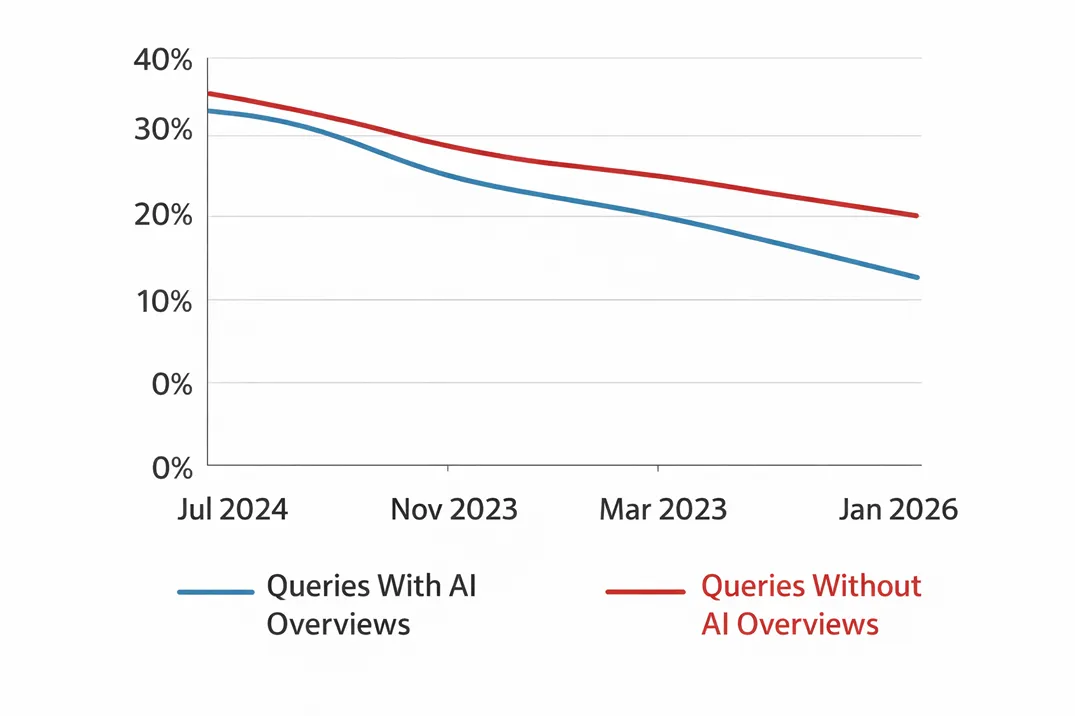
CTR decline over time comparing queries with and without AI Overviews from mid-2024 to early 2026
Which Types of Searches Are Most Affected
Not every search is hit equally. The type of query determines how much AI Overviews affect your traffic.
Informational and educational queries are the most affected. These include questions, definitions, how-to searches, tutorials, and comparison queries. They are the types of content that AI can summarise most easily. One study found that AI Overviews triggered on over 88% of informational intent queries.
Local searches are increasingly affected as well. Queries like "best plumber in Sydney" or "accountant near me" now often include an AI summary that pulls from review sites, Google Business Profiles, and local directories. Users may get enough information from the summary to make a decision without visiting individual websites.
Commercial queries with buying intent are seeing more AI Overviews than before, though the rate is still lower than informational queries. Google Ads appeared on 25.56% of AI Overview results by late 2025, up 394% from earlier that year. This shows Google is actively monetising the space, which means it will keep expanding.
Transactional queries remain the safest. When someone is ready to buy, book, or sign up, they still need to visit a website to complete the action. These searches continue to produce clicks at reasonable rates.
For most businesses, the traffic at risk is top-of-funnel content. The pages that bring people into your site through educational content are the ones losing clicks first. Service pages and product pages are more protected, but not immune.
The One Thing That Changes the Outcome
The data is not entirely negative. One finding from the Seer Interactive study stands out.
Brands that were cited inside AI Overviews earned 35% more organic clicks and 91% more paid clicks compared to brands that were not cited on the same queries. That is a significant difference.
Being mentioned as a source in the AI Overview changes the dynamic. Instead of competing with the AI answer, your brand becomes part of it. Users who want more detail click through to the cited source rather than scrolling past.
According to the same research, over 92% of AI Overview citations come from pages already ranking in the top 10. So traditional SEO is still the foundation. If your page is not ranking well, it will not be cited either.
However, ranking alone is no longer enough. Pages need to be structured and written in a way that makes them useful to the AI system. This is a different kind of optimisation than what most sites are currently doing.
The practical implication is straightforward. If you can get your content cited in the AI Overview, you actually gain an advantage over competitors who rank nearby but are not cited. If you are not cited, you absorb the full CTR decline.
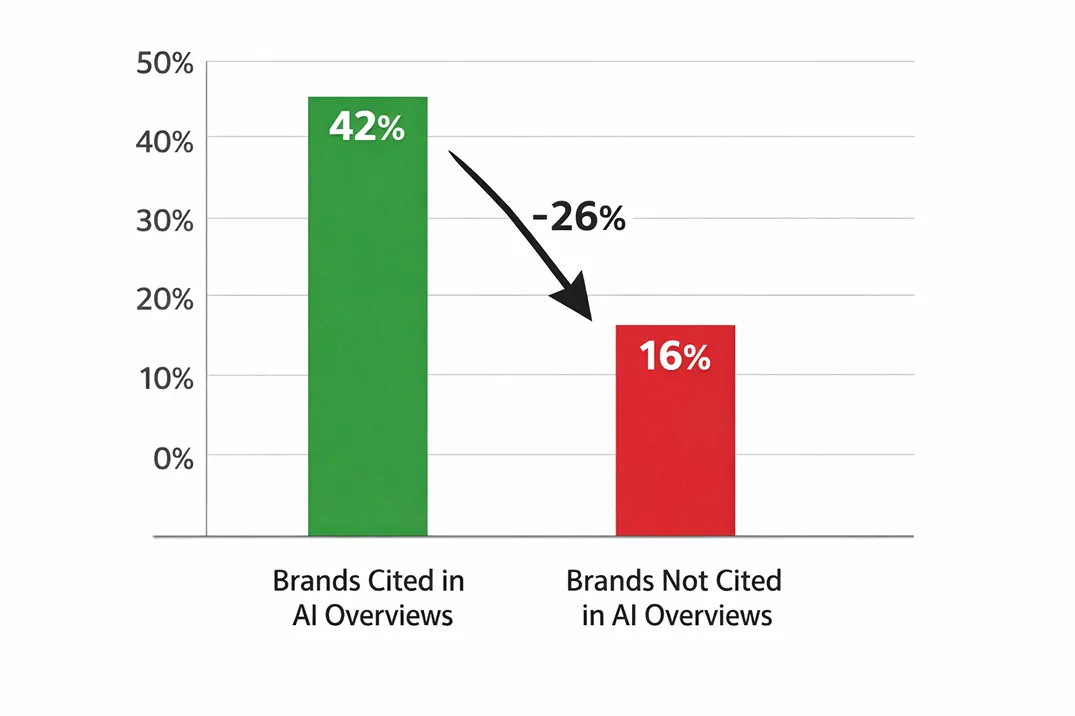
CTR difference between brands cited in AI Overviews versus those not cited
What Australian Businesses Should Do Now
Knowing the problem is not enough. The question is what to change in your approach so that your site does not just lose ground month after month. Here are the areas that matter most right now.
Audit Your Keywords for AI Overview Exposure
Before making changes, you need to know which of your ranking keywords trigger AI Overviews and whether your site is being cited.
Use Ahrefs or Semrush to filter your organic keywords by the "AI Overview" SERP feature. This shows you exactly where your traffic is exposed. You can also search your top 30 to 50 keywords manually in Google and note which ones return an AI Overview.
Sort these keywords into groups. Separate the ones tied to revenue (service pages, product pages) from the ones tied to awareness (blog posts, guides). Revenue keywords should be reviewed first.
If your pages are ranking but not being cited in the AI Overview, that is the gap to close. If your pages are not ranking at all for those queries, the priority is still improving position before worrying about AI citations.
Restructure Content So AI Can Use It
AI Overviews pull specific passages from web pages. The content that gets cited tends to follow a clear pattern.
- Start each article or page with a direct answer to the main question within the first 100 words, keeping that answer between 40 and 60 words
- Use headings that reflect how people actually search, as question-based headings align with how AI breaks a query into sub-questions
- Write in sections of 100 to 300 words that each address a single point, so AI systems can pull self-contained passages
- Include specific numbers, data points, and references where relevant, as AI systems prefer definitive, factual content over vague statements
Google uses a process called query fan-out, where it splits one search into related sub-questions and pulls content that answers each one. Pages that cover multiple angles of a topic with clear structure are more likely to be cited.
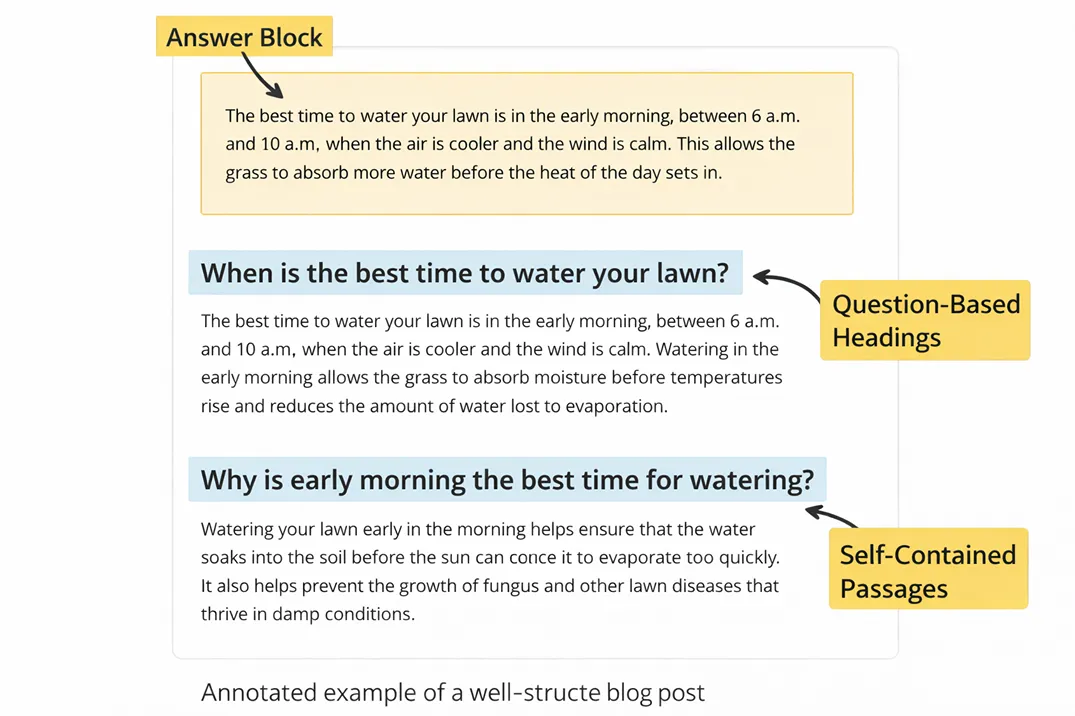
Example of content structure optimised for AI Overview citation
Shift How You Measure Success
If you are still measuring SEO performance only by organic sessions and click-through rate, you are missing part of the picture. Add these to your reporting alongside traffic metrics.
- SERP feature tracking tells you how often your pages appear in AI Overviews, featured snippets, and People Also Ask boxes
- Branded search volume shows whether people are searching for your business name after seeing it in AI results
- AI referral traffic can be tracked in Google Analytics 4 by checking AI-related referral sources
- Form attribution through a "How did you find us?" field with options like "Google AI Overview" gives direct feedback analytics cannot capture
The shift is from counting clicks to measuring influence. A page that gets cited in 500 AI Overviews per month without generating a single direct click is still shaping how potential customers perceive your business.
Protect Revenue by Focusing on Bottom-of-Funnel Content
Top-of-funnel content like "what is" guides and general how-to articles is the most exposed to zero-click behaviour. These pages will continue to lose traffic as AI Overviews improve.
The content that still earns clicks is bottom-of-funnel. This includes pricing breakdowns, case studies with specific results, comparison pages, detailed service descriptions, and pages where the user needs to take an action like booking, purchasing, or submitting an enquiry.
If your site relies heavily on informational blog posts to bring in traffic, now is the time to strengthen the pages that convert. Make sure your service pages are well-structured, clearly written, and internally linked from your educational content.
A technical SEO audit can identify whether your most important pages are sending the right signals and whether internal linking supports them properly.
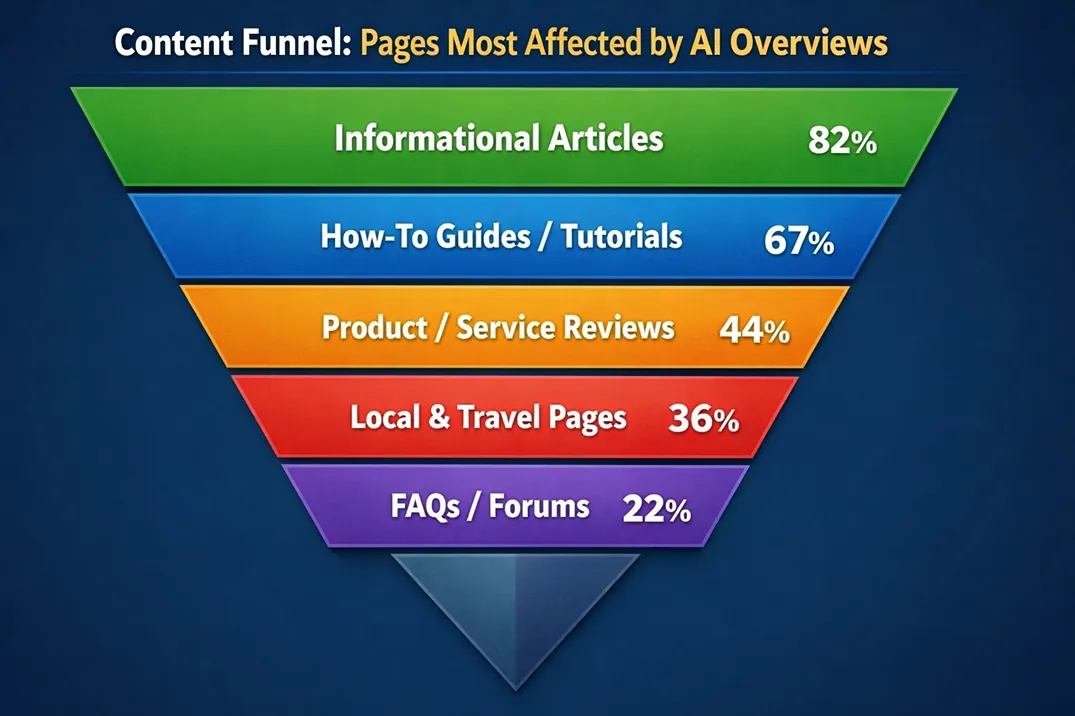
Content funnel showing which page types are most affected by AI Overviews
Build Brand Authority Beyond Your Website
One of the more surprising findings from recent research is that branded web mentions have a stronger correlation with AI Overview citations than backlinks do. The correlation for brand mentions was 0.664, while backlinks came in at 0.218.
This means how often your brand is mentioned across the web, on industry publications, forums, news sites, and social platforms, affects whether AI systems trust your content enough to cite it.
- Getting quoted or referenced in industry articles
- Contributing to relevant online communities
- Maintaining an active and accurate Google Business Profile
- Building a consistent presence on platforms where your audience already spends time
This is not about chasing links. It is about making your brand a recognisable name in your space so that when AI systems look for sources to cite, your business comes up naturally.
For local businesses in Australia, this ties directly into local SEO and business listing submissions. Consistent, accurate information across directories and review platforms reinforces the trust signals that AI systems rely on.
What This Means Going Forward
AI Overviews are not going away. Google reported that search ad revenues grew 17% in Q4 2025 despite falling CTRs, which means the model is working for Google and they have every reason to expand it further.
The businesses that will do well in this environment are the ones that accept the change and adapt their approach. That means writing content that is structured for both human readers and AI citation, measuring success by visibility and influence rather than clicks alone, and making sure the pages that generate revenue are protected and well-supported.
SEO is not finished. But it has changed. The sites that treat AI Overviews as a permanent part of search rather than a temporary problem will be in a much stronger position over the next 12 months.
If your pages are ranking but traffic is not growing the way it should, a combination of technical SEO review and content optimisation can help close the gap between visibility and results.