Google Business Profile is the single most important factor for ranking in the Local Pack. According to the 2026 Whitespark Local Search Ranking Factors survey, GBP signals account for approximately 32% of all map pack ranking influence. Complete, verified profiles appear 80% more often in search results and generate significantly more customer actions than incomplete listings.
For Australian businesses, this means your Google Business Profile is often the first and most impactful touchpoint with potential customers. Nearly 46% of all Google searches carry local intent, and the Local Pack captures between 40% and 50% of clicks on those queries. Users are increasingly making decisions directly from profiles without ever visiting a website.
This article explains how Google Business Profile optimisation works in 2026, which elements carry the most ranking weight, and the specific actions that improve both visibility and customer engagement for local businesses in Australia.
How Google Ranks Local Businesses in 2026
Google determines Local Pack rankings using three core factors: relevance, distance, and prominence. Relevance measures how well your profile matches the search query. Distance calculates how far your business is from the searcher. Prominence reflects how well-known and trusted your business appears across the web.
What has changed in 2026 is the growing weight of behavioural signals. Google now tracks how users interact with your listing: how often they click to call, request directions, view photos, ask questions, and visit your website. Listings that generate more real engagement tend to rank higher. This means a complete profile is no longer enough on its own. The profile needs to actively encourage interaction.
AI systems also play a larger role. Google's AI now cross-references your profile data with your website content, review sentiment, and citation accuracy to verify your business as a trustworthy entity. Inconsistencies between these sources reduce trust scores and limit visibility, particularly in AI Overviews where Google is increasingly surfacing local business recommendations.
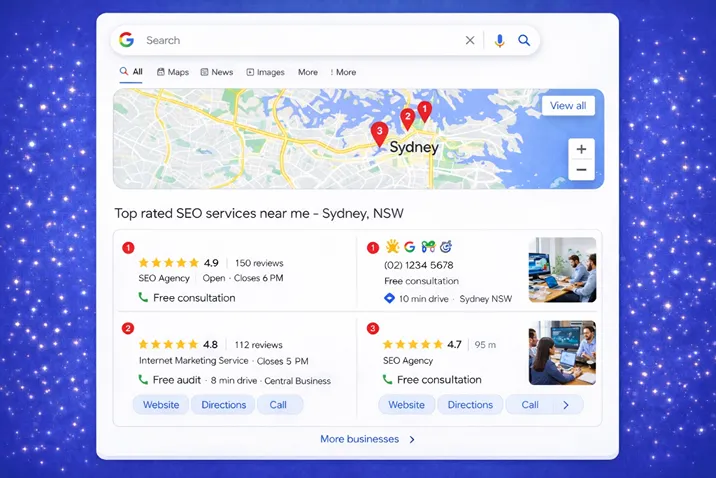
Google local pack showing business listings for a service search
Profile Elements That Carry the Most Ranking Weight
Not all profile fields are equal. The 2026 ranking factors data identifies specific elements that have the strongest influence on Local Pack placement.
Primary Business Category
Your primary category is consistently ranked as the single most influential individual factor in local search. Google uses over 4,000 available categories, and selecting the most specific one that matches your core service makes a measurable difference. Choosing "personal injury lawyer" rather than just "law firm" or "emergency plumber" rather than "plumber" improves relevance for the queries that matter most to your business.
Add secondary categories for every additional service you offer. These expand the range of queries your listing can match. Research from Localo found that approximately 75% of businesses ranking in the top three positions on Google had completed their profile descriptions and used specific category selections.
Profile Completeness
Profiles with 100% information completeness rank significantly higher than partially completed ones. Data from Birdeye shows that fully populated, verified profiles generate four times more website visits, 12% more calls, and 10% more direction requests than incomplete listings. Businesses with complete profiles are also 2.7 times more likely to be considered reputable by users.
Completeness means filling in every available field: services, attributes, business description, Q&A, products (if applicable), operating hours including special hours, and all relevant contact information. Profiles with complete and accurate information receive seven times more clicks than those with gaps.
Photos and Visual Content
Photos have a direct, measurable impact on engagement. Adding photos to your profile increases direction requests by 42% on average. Verified profiles with 15 or more photos per location see stronger engagement across all customer actions. Google interprets photo recency, quality, and relevance as trust signals, so uploading fresh images regularly matters more than having a large static library.
Upload photos that show your team, your premises, your work, and your local area. Geotag images where possible to reinforce location relevance. Short video content is also gaining weight as a ranking signal. Businesses that upload monthly see consistent visibility advantages over those that set and forget their visual content.
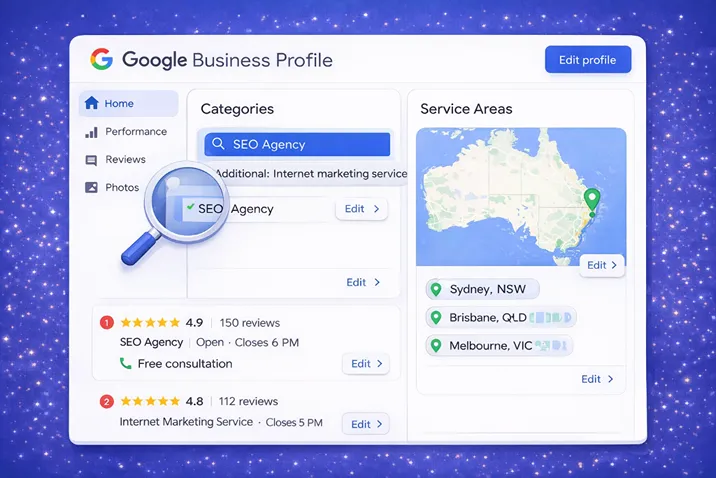
Google Business Profile dashboard highlighting categories and service areas
Reviews: The Trust Signal Google Weighs Heavily
Review signals account for roughly 15% of Local Pack ranking factors. Google evaluates review quantity, recency, sentiment, and the specific language used in review text. Each additional review your business receives correlates with approximately 80 additional website visits, 63 direction requests, and 16 calls according to Birdeye's analysis.
Review velocity matters as much as total count. A steady stream of new reviews signals ongoing customer activity and trust. Businesses ranking in the top three positions on Google typically have around 240 reviews, while those outside the top three have considerably fewer. Businesses maintaining a rating of 4.5 stars or higher attract 68% more clicks than lower-rated competitors. Most consumers will not consider a business with fewer than three stars.
- Ask customers to describe their experience in detail rather than leaving generic star ratings, as Google reads review text for relevance signals
- Respond to every review, both positive and negative, as response activity is an engagement signal and builds trust with future customers
- Address negative reviews with transparency and a solution-focused response rather than ignoring or disputing them
- Flag fake or policy-violating reviews promptly through Google's support channels
Google is the largest review platform in the world, with 83% of consumers reading Google reviews before engaging with a business. Your review profile is often the deciding factor between a click and a scroll-past.
How Your Profile Connects to Website SEO
Google does not evaluate your profile and website in isolation. In 2026, the algorithm treats your business as a single entity and cross-references signals between your GBP, your website, your citations, and your reviews. When all of these align, trust increases. When they conflict, visibility drops.
Specifically, Google compares your GBP service descriptions with the content on your website service pages. If your profile lists services that your website does not mention, or if your NAP data differs between platforms, the inconsistency reduces confidence in your listing. Implementing LocalBusiness schema markup on your website reinforces your GBP data by providing structured confirmation of your name, address, phone number, service areas, and opening hours.
Website visits account for 48% of all GBP interactions, making it the most common action users take from a profile. Direction requests make up around 29% to 38%, and calls account for 17% to 27%, depending on the industry. This means your website needs to be fast, mobile-friendly, and consistent with what your profile promises. A disconnect between profile and website undermines both ranking and conversion.
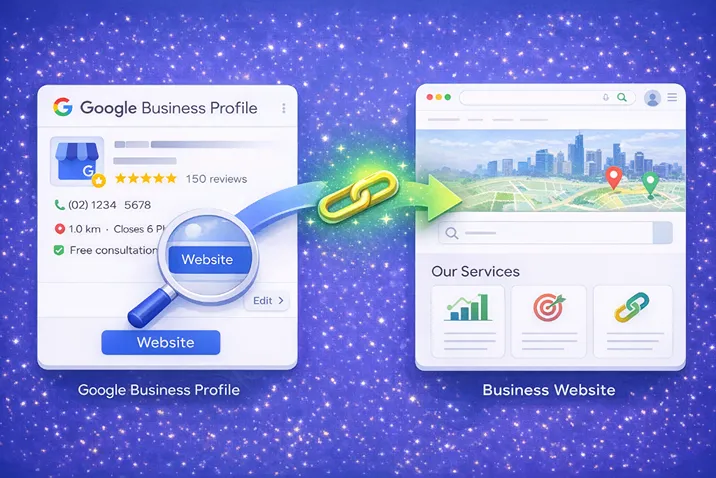
Diagram showing Google Business Profile linking to a business website
NAP Consistency and Citation Accuracy
Name, Address, and Phone number (NAP) consistency remains essential for local rankings. Google uses citations across directories, data aggregators, and platforms to verify that your business exists, is located where you say it is, and is contactable at the number you provide. Even small formatting differences, such as "St" versus "Street" or a missing suite number, can reduce confidence if repeated across multiple sources.
Citation signals are also increasingly important for AI visibility. The 2026 Whitespark survey found that three of the top five AI search visibility ranking factors are citation-related: presence on expert-curated lists, prominence on industry-relevant sites, and the quality of unstructured citations like news articles and blog mentions.
For Australian businesses, this means maintaining accurate data across Google Business Profile, Apple Maps, Bing Places, Yellow Pages, True Local, and industry-specific directories. A structured listing submission process prevents errors from accumulating as your business grows or changes details.
GBP and AI Overviews: The New Visibility Layer
AI Overviews now appear for a growing number of local queries. When someone searches "best accountant in Melbourne" or "emergency dentist near me," Google may generate an AI summary that pulls information from business profiles, review sites, and local directories before displaying traditional results.
Google's AI systems prioritise profiles that have complete, accurate data, active engagement, and strong review sentiment. Businesses with well-optimised profiles are more likely to be mentioned in AI-generated local recommendations. This matters because being named in an AI answer builds trust and recognition even when the user does not click through to a website.
As zero-click local searches increase, the profile itself becomes the primary conversion surface. Users check hours, read reviews, tap to call, and request directions without visiting a website. Making sure your profile is complete, current, and engaging is no longer just about ranking. It is about converting directly from the search results page. For more on how AI search is changing click behaviour, see how AI Overviews are changing click-through rates in 2026.
Location Pages and Multi-Location Considerations
Google Business Profile optimisation is most effective when supported by location-specific website pages. While profiles help businesses appear in map results, location pages provide the on-site context that reinforces relevance and trust.
Each location page should reflect the services, team, and area specific to that branch. Google's AI cross-references your website service descriptions with your GBP services tab, so alignment between the two is critical. Pages that repeat the same content with only the city name changed provide no unique value and are increasingly penalised.
For businesses operating across multiple suburbs or cities in Australia, each location needs its own GBP listing and its own dedicated website page. Location-specific pages like SEO services in Sydney help reinforce local relevance for each area. For a detailed approach to scaling this, see local SEO for multi-location businesses in Australia.
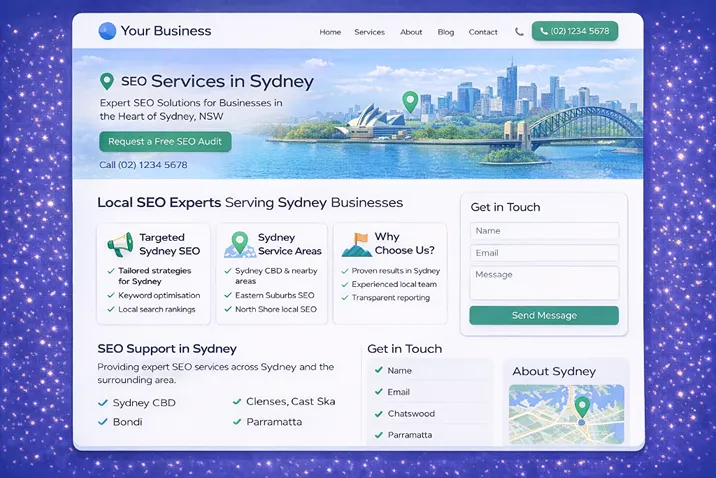
City-specific service page supporting local search visibility
Ongoing Maintenance: Why Set-and-Forget Fails
A well-optimised profile at launch will decline in visibility over time without ongoing activity. Google's algorithm increasingly rewards profiles that show consistent activity: regular posts, fresh photos, recent reviews, and up-to-date information. Listings with recent posts receive 21% more user interactions than inactive ones.
Google Posts function as short updates that appear directly on your listing. They remain visible for seven days, so a weekly posting schedule keeps your profile fresh. Post types that perform best include offers, events, and practical tips related to your services. "Update" posts tend to get less visibility than offer or event formats.
- Post to your profile at least weekly with offers, tips, or business updates
- Upload new photos monthly showing recent work, team activity, or location-specific content
- Update operating hours, services, and attributes whenever anything changes
- Monitor and respond to Q&A questions on your profile, as Google's Gemini AI may surface these answers to searchers
- Track performance metrics (calls, direction requests, website clicks) monthly and adjust your approach based on what generates the most customer actions
The average Google Business Profile drives around 200 clicks per month and 81 total customer actions (calls, direction requests, and website visits combined). Well-maintained profiles consistently exceed these benchmarks. Profiles that are left unchanged after initial setup gradually fall behind competitors who treat their listing as an active marketing channel.