Local SEO for multi-location businesses in Australia requires treating each location as a separate visibility problem. A single SEO strategy does not scale when rankings depend on location-specific business profiles, dedicated pages, review signals, and area-based content that varies from one city or suburb to the next.
Nearly half of all Google searches carry local intent, and businesses appearing in the Local Pack (the top three map results) capture between 40% and 50% of clicks for those queries. For multi-location businesses, the challenge is earning that visibility consistently across every location, not just the headquarters or strongest branch.
This article explains how local SEO works across multiple locations in Australia, what the 2026 ranking factors data shows, and how to structure your site, profiles, and content so each location performs independently while supporting the brand as a whole.
Why Multi-Location SEO Requires a Different Approach
A business with one location can focus all SEO effort on a single Google Business Profile, one set of local keywords, and one address. When that business opens a second, third, or tenth location, every signal that drives local rankings needs to be replicated and tailored for each new area.
Without a structured approach, two problems emerge. The first is signal concentration, where all authority and visibility stays with the original location while newer branches remain invisible. The second is signal dilution, where poorly coordinated pages and profiles spread authority so thinly that no single location ranks well.
Each location competes in its own local market. A page targeting "electrician in Sydney" cannot rank for "electrician in Brisbane." Each location needs its own page, its own business profile, its own reviews, and its own local signals. The businesses that scale local SEO successfully treat every branch as a standalone local SEO project connected by a shared brand structure.
In Australia, this is particularly relevant because of how spread out the major cities are. A business operating across Sydney, Melbourne, Brisbane, Perth, and Adelaide is competing in five completely separate local search markets, each with its own competitors, search patterns, and user behaviour.
What Actually Drives Local Pack Rankings in 2026
Google ranks local businesses using three core factors: relevance (how well your listing matches the query), distance (how close you are to the searcher), and prominence (how well-known and trusted your business appears online). These three pillars still form the foundation of Local Pack rankings in 2026.
The Whitespark 2026 Local Search Ranking Factors survey, based on input from 47 local search experts reviewing 187 factors, breaks down the relative weight of each signal group. For the Local Pack specifically, Google Business Profile signals account for approximately 32% of ranking influence. Reviews and on-page signals make up the next largest portions, followed by link signals, citations, behavioural signals, and personalisation.
What has changed in 2026 is the growing importance of behavioural signals. Google now evaluates how users interact with your listing: clicks, calls, direction requests, photo views, and time spent on your profile. Listings that generate more real user engagement tend to rank higher. For multi-location businesses, this means every branch needs an active, well-maintained profile that encourages interaction, not just a complete one.
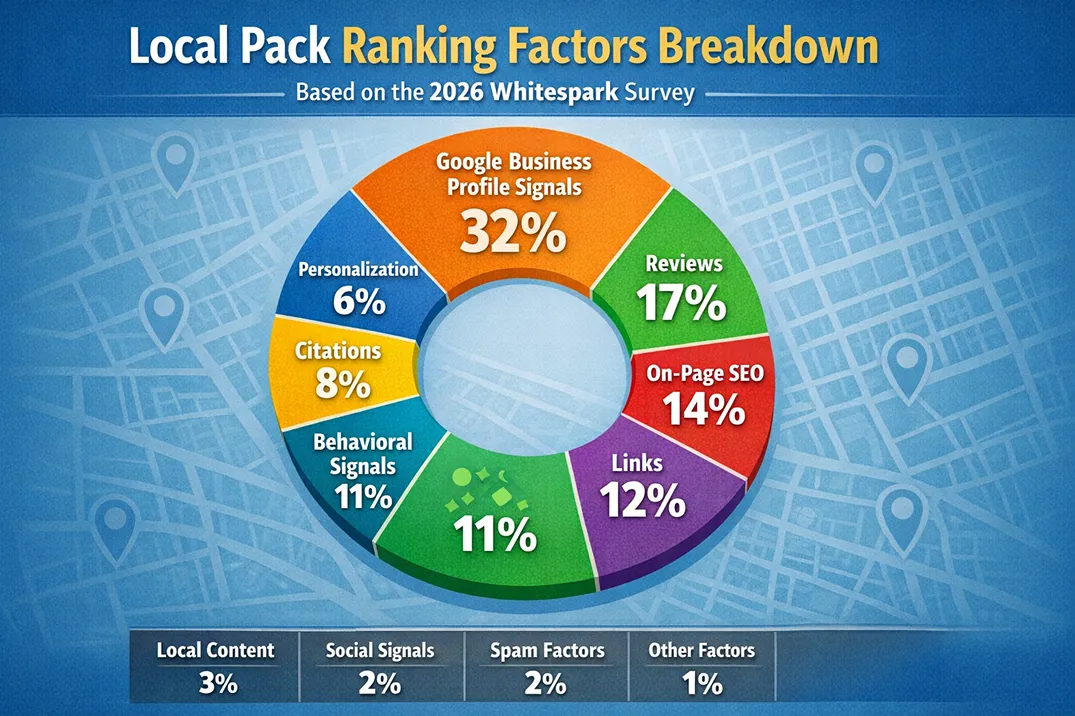
Local Pack ranking factor breakdown based on the 2026 Whitespark survey
Google Business Profile: The Foundation for Every Location
Your Google Business Profile is the single most important asset for local rankings. The primary business category you select is consistently identified as the strongest individual ranking factor in local search studies. Getting this right for every location is the first priority.
Each location needs its own verified Google Business Profile with accurate and complete information. This includes the correct primary category, relevant secondary categories, full service lists, accurate hours, photos specific to that location, and a description that reflects what the branch offers.
- Set the most specific primary category available rather than a broad one (for example, "personal injury lawyer" performs better than just "law firm")
- Add secondary categories for all additional services offered at that location
- Upload location-specific photos regularly, as Google interprets photo recency and quality as trust signals
- Post GBP updates weekly to signal that the listing is active and maintained
- Fill in all attributes, Q&A, and service descriptions for maximum profile completeness
Over half of Google Business Profile interactions result in website visits, and 42% of local searches lead to clicks on the Local Pack. Yet research suggests that 56% of retailers have not even claimed their profile. For multi-location businesses that take this seriously, the opportunity is significant. A complete and active profile at every branch creates a competitive advantage in markets where many competitors have incomplete or neglected listings. For more detail on profile optimisation, see the Google Business Profile optimisation guide.
Location Pages That Actually Rank
Every physical location or distinct service area needs its own dedicated page on your website. These pages serve two purposes: they give Google a clear signal of where you operate, and they give potential customers location-specific information that helps them choose your business.
The most common mistake multi-location businesses make is creating templated location pages where only the city name changes. Google's AI systems are increasingly able to detect this. Pages that copy the same content and swap in a different suburb or city name provide no unique value, and AI Overviews will not cite them because there is nothing to differentiate one from another.
Research shows that using genuinely localised content on each location page can improve rankings significantly. Effective location pages include the specific services offered at that branch, the team or staff at that location, the suburbs or areas served from that office, local landmarks or context that ground the page in the real area, and reviews or testimonials from customers in that location.
Location pages and service pages serve different roles. Location pages target geographic queries like "plumber in Parramatta" and answer "do you serve my area?" Service pages target non-geographic queries like "emergency plumbing services" and answer "what do you offer?" When both exist with proper internal linking between them, they reinforce each other and create stronger signals for both types of search.
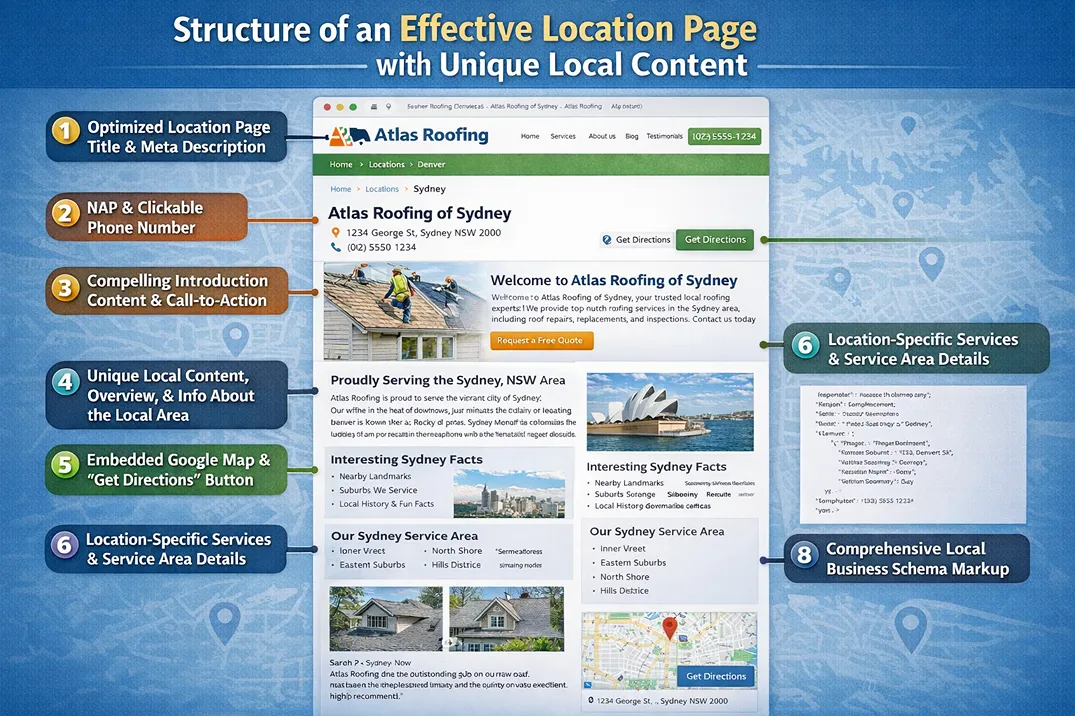
Structure of an effective location page with unique local content
NAP Consistency and Citation Management
Name, Address, and Phone number (NAP) consistency across the web is a foundational trust signal for local rankings. When your business details differ between your website, Google Business Profile, directories, and review sites, it creates uncertainty for both search engines and AI systems trying to verify your information.
The 2026 Whitespark survey highlights that citation-related factors are particularly important for AI search visibility. Three of the top five AI visibility ranking factors are citation-related, including presence on curated "best of" lists, prominence on industry-relevant sites, and the quality of unstructured citations like news articles and blog mentions.
For multi-location businesses, citation management becomes exponentially more complex. Every location needs consistent NAP data across every directory, data aggregator, and platform where it appears. A single format inconsistency (like "St" versus "Street" or a missing suite number) repeated across dozens of listings can erode confidence in that location's data.
In Australia, this means maintaining accuracy across platforms like Google Business Profile, Apple Maps, Bing Places, Yellow Pages, True Local, Hotfrog, and industry-specific directories. A structured listing submission process helps ensure each location starts with clean, consistent data rather than accumulating errors over time.
Reviews: The Trust Signal That Scales Per Location
Review signals account for a significant portion of Local Pack ranking influence. Both the quantity and the velocity of reviews matter. A steady stream of recent reviews signals to Google that the business is active and that real customers are choosing it. A burst of reviews followed by months of silence is less effective than consistent, ongoing feedback.
For multi-location businesses, review performance often varies dramatically between branches. The headquarters or flagship location might have hundreds of reviews while newer branches have fewer than ten. This directly affects each location's ability to rank in its local market.
- Set up a review generation process at every location, not just the main office
- Respond to every review (positive and negative) promptly, as response activity is an engagement signal
- Encourage customers to describe their experience in detail rather than leaving one-word reviews, as Google reads review content for relevance signals
- Monitor review sentiment across all locations and address patterns that suggest service issues at specific branches
Google's AI now reads review sentiment and content. Reviews that mention specific services, staff names, or outcomes carry more weight than generic five-star ratings. One weak location with poor reviews can also affect how AI systems perceive the overall brand, so maintaining quality across every branch is essential.
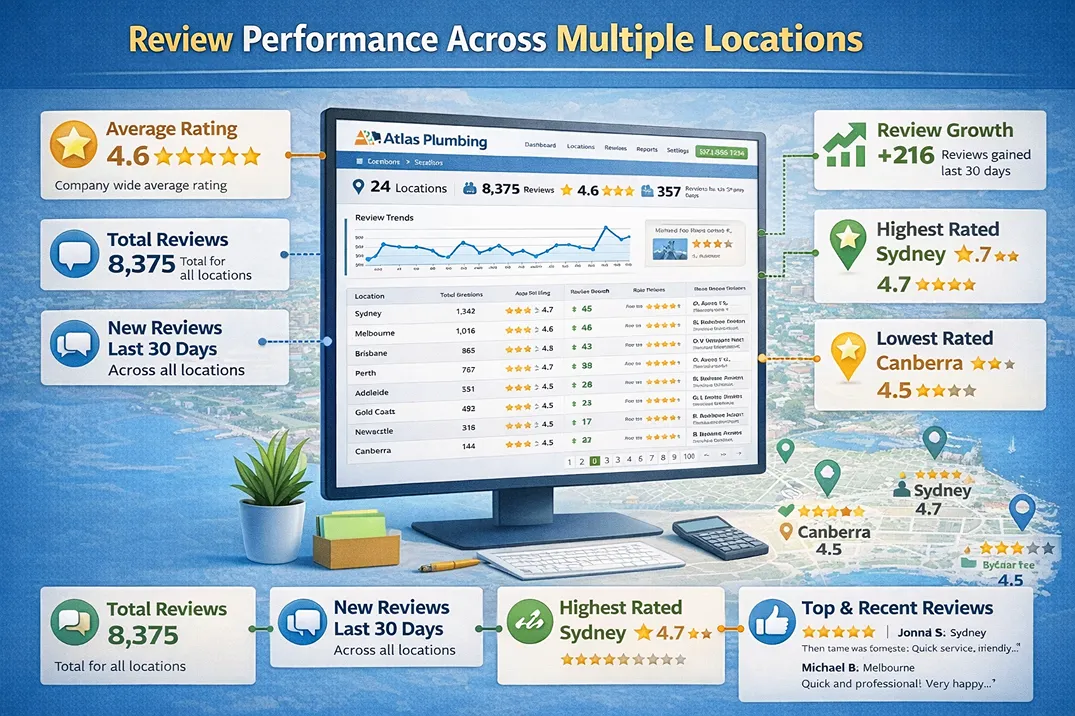
Review performance across multiple locations
Internal Linking Structure for Multi-Location Sites
Internal linking determines how authority flows between pages on your site. For multi-location businesses, a deliberate linking structure ensures every location page receives enough internal authority to compete in its local market.
A scalable structure typically follows this pattern: the homepage links to main service pages, service pages link to relevant location pages, and location pages link back to the service pages for the services available at that branch. This creates a clear hierarchy where Google can understand both the service offerings and the geographic coverage.
Without deliberate linking, newer location pages often become orphaned. They exist on the site but receive no internal links, which means Google assigns them low priority. If your location pages are not being indexed promptly, weak internal linking is often the cause. This is the same structural issue covered in why pages stay in discovered currently not indexed.
Keep location pages within two to three clicks from the homepage. If users (and crawlers) need to navigate through multiple layers to reach a location page, it signals lower importance and reduces crawl priority.
How AI Overviews and Zero-Click Search Affect Multi-Location Businesses
Local queries are increasingly showing AI-generated summaries. Searches like "best accountant in Melbourne" or "emergency plumber near me" now often include an AI Overview that pulls information from Google Business Profiles, review sites, and local directories before any organic results appear.
For multi-location businesses, this creates both a risk and an opportunity. The risk is that users get enough information from the AI summary to make a decision without visiting your website. The opportunity is that if your business is mentioned by name in the AI answer, you gain trust and recognition that competitors without citations miss entirely.
The 2026 ranking factors data shows that three of the top five factors for AI visibility are citation-related. This means businesses with clean, consistent data across directories, strong review profiles, and presence on authoritative local sites are more likely to be surfaced in AI answers.
Multi-location businesses that maintain high-quality profiles, generate consistent reviews, and publish genuinely localised content at every branch are better positioned for AI citation than businesses that treat local SEO as a one-time setup. For a broader view of how AI Overviews are affecting search behaviour, see how AI Overviews are changing click-through rates in 2026.
Common Mistakes in Multi-Location SEO
Several patterns consistently undermine multi-location performance. Recognising these early prevents wasted effort and compounding problems as more locations are added.
- Template location pages where only the city name changes. AI systems detect this and it provides no unique value for ranking or citation
- Creating fake location pages for areas where the business has no physical presence. Google penalises this, and enforcement has tightened in recent updates
- Neglecting review management at secondary locations, leaving newer branches with thin review profiles that cannot compete locally
- Inconsistent NAP data that accumulates across directories as locations are added or addresses change
- Adding keywords to the Google Business Profile name when it is not the registered business name, which increases suspension risk
A technical SEO audit can identify which of these issues are present and prioritise fixes based on which locations are underperforming relative to their potential.
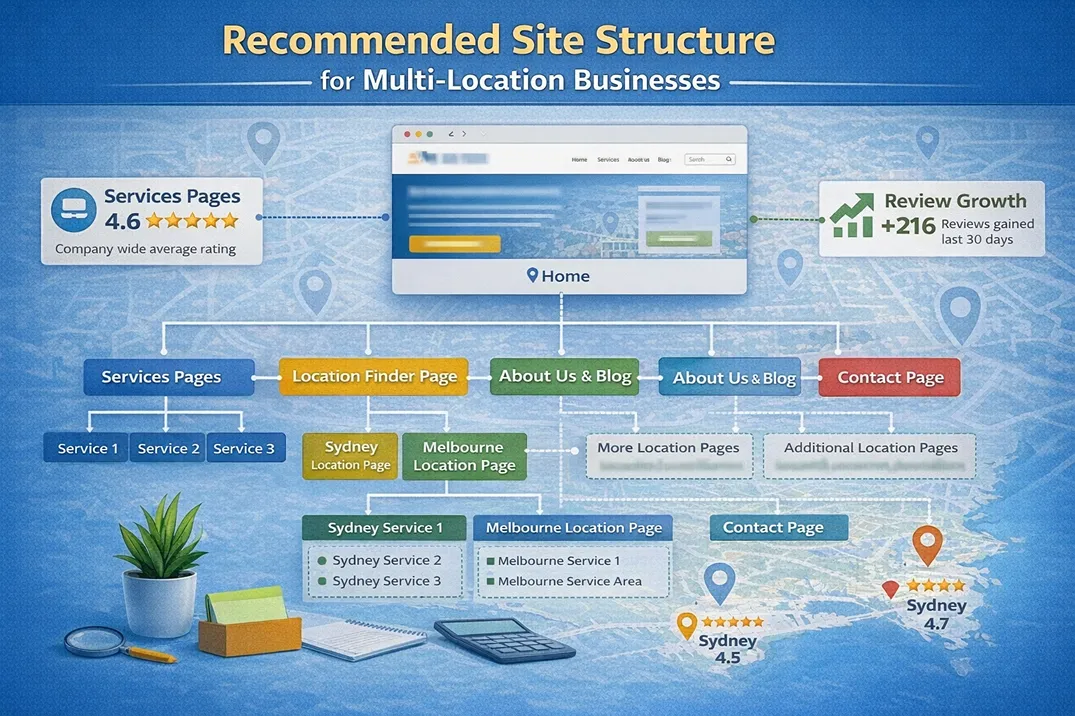
Recommended site structure for multi-location businesses
A Practical Checklist for Scaling Local SEO Across Locations
When adding a new location or auditing existing branches, work through these steps for each one.
- Claim and verify a Google Business Profile with the correct primary category, full service list, and location-specific photos
- Create a dedicated location page with unique content specific to that branch, suburb, and service area
- Submit consistent NAP data to Australian directories including Yellow Pages, True Local, and industry-specific platforms
- Implement LocalBusiness schema markup on each location page with correct address, coordinates, and opening hours
- Add internal links from service pages and the homepage to the new location page
- Set up a review generation process for the new branch from day one
- Schedule weekly GBP posts and regular photo uploads to maintain listing activity signals
This process should be repeatable. The businesses that scale local SEO successfully have a documented workflow for each new location that covers profile setup, page creation, citation submission, and ongoing maintenance. Without a system, quality degrades as the number of locations grows.