How Do I Know If My SEO Is Actually Working?
You have been told SEO takes time. You are paying for it, or you have put work into it yourself, and you genuinely cannot tell if anything is happening. Your reports show graphs that trend upward but the phone is not ringing any more than it was three months ago.
This is one of the most common situations small business owners find themselves in. It is not a sign that SEO does not work. It is usually a sign that nobody has explained what to look at, when to look at it, and what it actually means.
This article gives you five concrete signals you can check yourself, a realistic picture of what progress looks like at different stages, and a clear set of warning signs that suggest something may genuinely be wrong.
SEO Progress and Revenue Are Not the Same Measurement
Before looking at any numbers, it helps to understand why SEO results feel invisible for so long.
SEO moves through stages. The early stage is about Google gaining confidence in your site. Rankings shift. Pages start appearing for more queries. Impressions grow in Search Console. None of this produces calls or sales yet, but it is measurable progress.
The middle stage is when positions strengthen and traffic starts to move. Pages that were ranking at position 14 reach page one. Organic visits to your service pages increase. This stage is where most businesses start to feel results, usually between three and six months depending on the competition in their market.
The late stage is when traffic converts. Users find your site, read your service pages, and make enquiries. This is the outcome everyone is paying for, but it cannot happen before the earlier stages are complete.
Measuring SEO only by calls and enquiries in the first 90 days is like measuring a building by whether people are moving in while the foundation is still being poured. The wrong measurement at the wrong stage produces a false conclusion.
What you need in the early stage are leading indicators. These are the signals that tell you progress is happening before the revenue follows.
Five Signals That Tell You SEO Is Moving
1. Your Impressions in Google Search Console Are Climbing
Impressions are the number of times your pages appeared in Google search results, regardless of whether anyone clicked. They are one of the earliest signals that SEO work is having an effect.
To check this, open Google Search Console, go to the Performance report, and look at the Total Impressions line over the last 90 days. A consistent upward trend means Google is showing your site to more people for more queries. A flat line after 90 days of active work is worth questioning.
Impressions rising without clicks is normal in the early stage. It means your pages are appearing but ranking too low to earn clicks yet. That is still forward movement. It becomes a problem if impressions grow for months without any improvement in position.
For a plain-language explanation of why pages can have impressions but no clicks, the article on why indexed pages get no clicks covers the specific reasons in detail.
2. You Are Appearing for More Search Queries Than Before
In the same Performance report, click on the Queries tab. This shows every search term your site appeared for. Compare the number of queries from the first 30 days of work against the most recent 30 days.
If SEO is working, you will see new, relevant queries appearing over time. Not just your business name. Terms like "electrician Newcastle" or "ecommerce accountant Sydney" or whatever is relevant to your services.
This matters because it shows Google is beginning to understand what your site is about and who it should show it to. A site that only ranks for its own brand name has not made any SEO progress yet. A site that starts appearing for dozens of relevant service terms is gaining real ground.
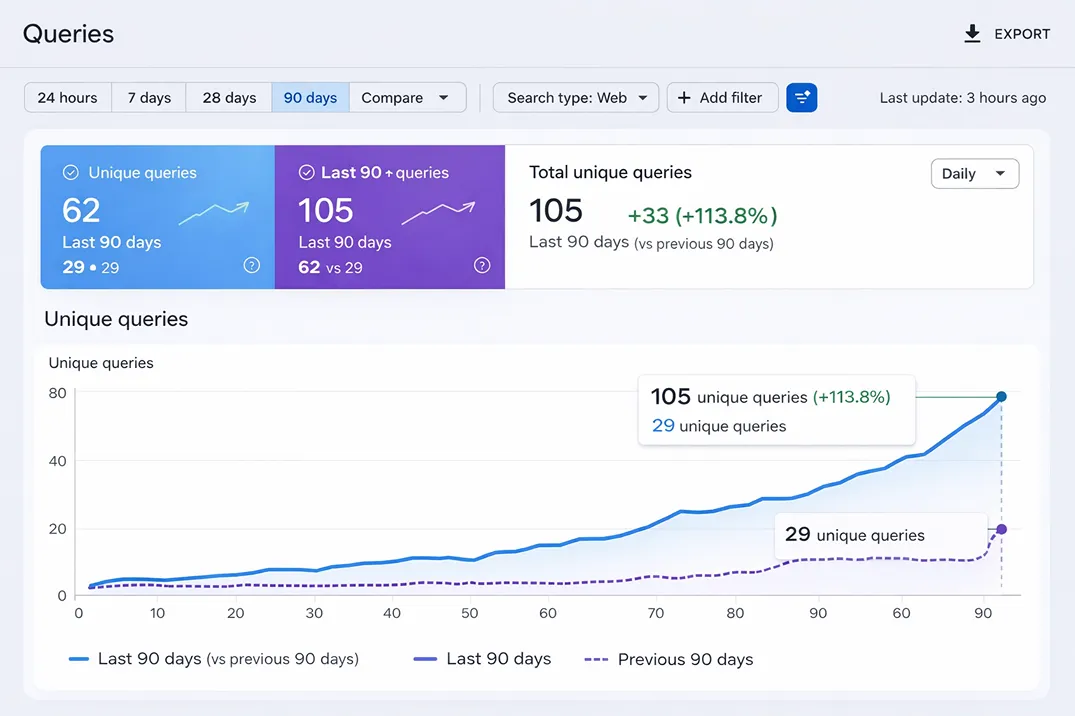
Google Search Console Queries tab showing growth in unique queries over a 90-day comparison period
3. Your Google Business Profile Is Getting More Views and Actions
For trades, local services, and any business that serves a specific area, Google Business Profile visibility is a direct measure of local SEO health.
Inside your Google Business Profile dashboard, the Insights section shows how many people found your profile through search, how many clicked to call, and how many asked for directions. These numbers update monthly.
If local SEO work is being done properly, GBP views and actions should increase over time. A profile that was barely appearing in the map pack should start showing up more frequently for searches in your service area. The actions metric, calls, direction requests, and website clicks, is the one most directly tied to real enquiries.
If your profile views have been flat or declining for several months despite active SEO work, that is a signal worth investigating. Common causes include an incomplete profile, citation inconsistencies across Australian directories, or a competitor with stronger local signals taking the positions you are trying to reach. These are all factors that local SEO work addresses as a combined signal set rather than individual fixes.
4. Your Target Pages Are Moving Up in Average Position
In Google Search Console, you can filter the Performance report by page. Select your most important service pages one at a time and look at the Average Position metric over the last three to six months.
Average position is the mean ranking your page holds for all the queries it appears for. A lower number means a higher ranking. Moving from position 22 to position 11 is significant progress even though you are still not on page one. It tells you the page is gaining authority and moving in the right direction.
The important thing here is to look at your service pages specifically, not your homepage or blog posts. Rankings moving on pages that generate enquiries is the signal that matters. Rankings moving on pages that nobody visits for a commercial reason is largely irrelevant to your business outcome.
If your service page has been sitting at the same average position for four months without movement, that points to a specific on-page or technical problem rather than SEO simply taking time. Title tags, heading structure, intent alignment, and internal linking are usually where stalled pages break down, and those are exactly what on-page SEO reviews first.
5. Organic Traffic to Your Service Pages Is Increasing
Total site traffic is a useful number but it is also the most misleading one. A spike in organic traffic can come entirely from a blog post about a trending topic that has nothing to do with your services. That traffic arrives, bounces, and contributes nothing to your business.
The traffic that matters is organic traffic to the pages that exist to generate enquiries. Filter your analytics to show only organic sessions landing on your service pages. Compare the last 30 days to three months ago and to six months ago.
A clear upward trend here, even a modest one, is a strong positive signal. It means people are finding your service pages through Google searches and visiting them. If organic traffic to your service pages has been flat or declining while your total traffic has grown, the growth is happening in the wrong place. That is a content strategy problem, not a sign that SEO is failing.
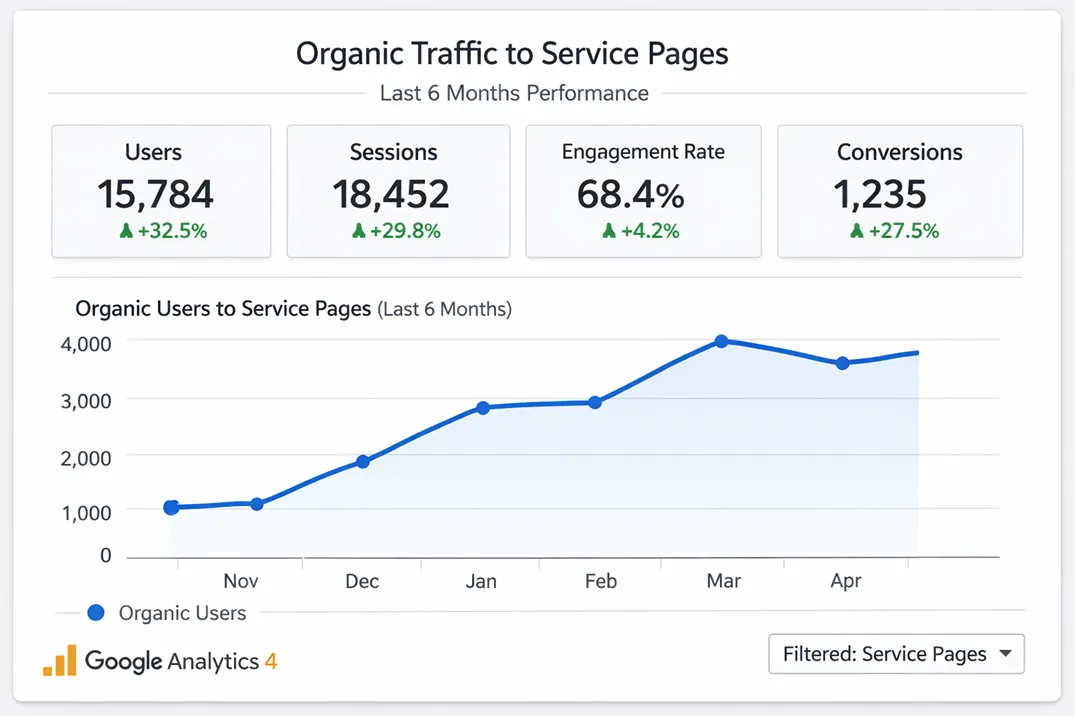
Google Analytics 4 organic traffic filtered to service pages only, showing a six-month trend
What Realistic Progress Looks Like at 30, 60 and 90 Days
A common source of frustration is expecting the wrong outcome at the wrong time. Here is what you should realistically see at each stage, assuming active work is being done consistently.
At 30 days
Impressions in Search Console should be showing early movement if technical issues have been addressed and on-page work has started. GBP optimisation changes typically reflect in local visibility within two to four weeks. Meaningful traffic or ranking movement is unlikely at this stage, and that is normal.
At 60 days
Rankings on target pages should be shifting. Average positions should be moving, even if they have not reached page one. New queries appearing in the Performance report is a strong sign at this stage. Local businesses should be seeing GBP views trending upward.
At 90 days
Some service pages should be approaching page one positions or already there for less competitive terms. Organic traffic to service pages should show a clear upward trend compared to the baseline. For businesses in competitive markets, the most significant movement often comes between months four and six rather than at the 90-day mark.
These timelines assume the site did not have major technical problems to resolve first. If the first month of work was spent fixing crawl errors, redirect issues, or indexing problems, the clock on ranking progress effectively starts from when those issues were resolved. A technical SEO audit at the outset establishes a clean baseline and identifies any structural problems that would otherwise slow progress for months.
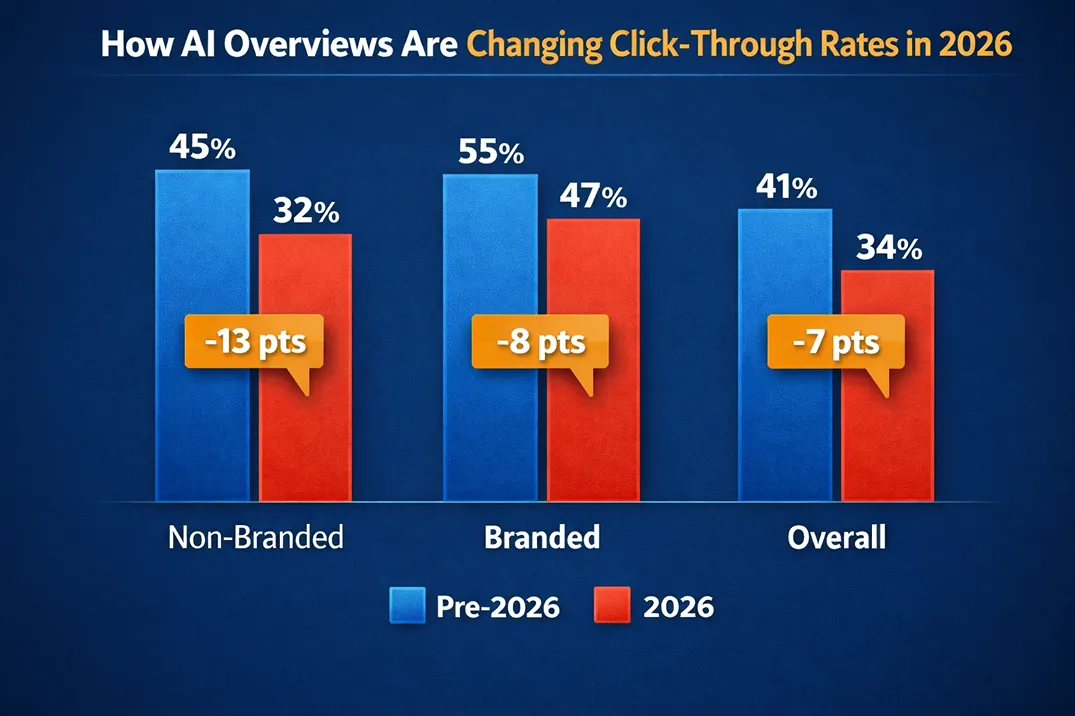
It is also worth noting that 2026 search behaviour means some traditionally strong traffic signals are less reliable than before. AI Overviews now appear for a significant portion of informational searches and reduce the click-through rate even for pages ranking in position one. The article on how AI Overviews are changing CTR in 2026 explains which query types are most affected and what it means for how you measure results.
Signs That Something May Genuinely Be Wrong
Slow early progress is normal. These things are not.
No access to Google Search Console
If you are paying for SEO and do not have your own access to Search Console, fix this immediately. You cannot verify any progress without it. Any legitimate SEO provider will add you as a user on day one.
Reports that only show traffic graphs
A report that shows you a traffic trend without explaining what work was done that month is not an SEO report. Legitimate SEO work produces a written record of what was changed, which pages were updated, which citations were submitted, and what the next priority is.
No movement in average position after four months
Some fluctuation is normal. Complete stagnation on every target page for four consecutive months is not. It suggests either that no meaningful work is being done or that a technical issue is blocking progress that has not been identified.
Rankings only for your business name
If the only queries you rank for are your exact business name and variations of it, your SEO has not started yet from a practical standpoint. Brand rankings exist naturally for almost any business with a website. They are not a measure of SEO progress.
New content published without improving existing pages
Publishing new blog posts every month while your service pages sit at position 30 with no changes is a common tactic that produces traffic without producing leads. New content has its place, but it should not come at the expense of the pages that exist to generate business.
What to Do If You Are Still Not Sure
If you have checked the signals above and the picture is still unclear, the most useful next step is an independent review that looks at your site without any prior assumptions about what has or has not been done.
A technical SEO audit looks at your site's crawl health, indexing, on-page signals, and site structure. It identifies whether the problems holding back your rankings are technical in nature, which is often the case when months of content work and GBP optimisation have not moved the needle. It also tells you the order in which problems should be addressed so that future work actually produces results.
The audit is delivered as a written document with a prioritised fix list. Your developer can work from it directly, or you can use it as a clear brief for whoever is doing your SEO.