What to Fix First When Google Search Console Shows Coverage Errors
Coverage errors in Google Search Console represent a specific indexing problem: pages that should be indexed but are not. These errors indicate that search engines attempted to process pages but could not add them to the search index.
Understanding what causes coverage errors and how to resolve them is essential for ensuring that important pages are discoverable in search results. Each error type reflects a different underlying issue that requires specific correction.
This article explains how to identify coverage errors, understand what each error means, and implement fixes that restore indexing.
What Coverage Errors Indicate
Coverage errors appear in Google Search Console when a page is discoverable by search engines but cannot be added to the search index. These are distinct from issues where pages are never crawled — coverage errors imply that Google attempted indexing but encountered a specific barrier.
Common causes include noindex tags, redirect loops, server errors, or content issues that prevent successful indexing. Each category of errors requires different diagnostic steps and solutions.
Addressing coverage errors is often the first step in improving search visibility because they represent a hard block — pages cannot rank if they are not indexed, regardless of content quality or relevance signals.
Common Coverage Error Types
Google Search Console categorises coverage errors into distinct types, each with different root causes and solutions.
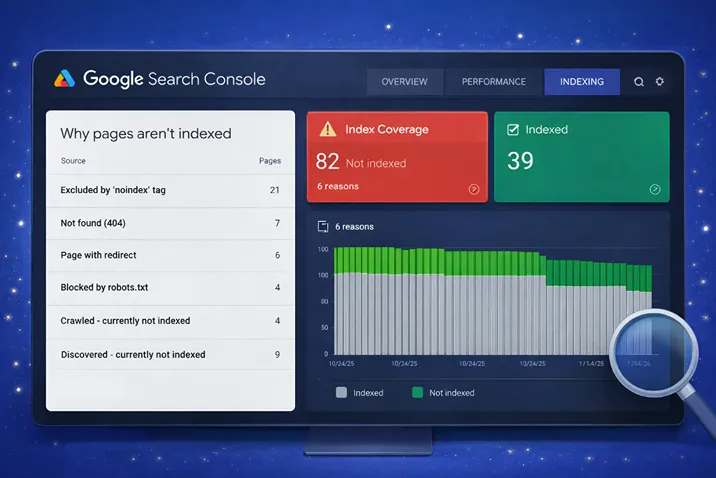
- Indexed, though marked as "noindex" — Page was indexed before noindex tag was added. Needs noindex removal or reindexing request
- Excluded by 'noindex' tag — Intentionally prevented from being indexed. Deliberate exclusion that may be correct or may need reversal
- Submitted URL appears as a different canonical URL — Duplicate or redirect issue where Google is consolidating pages
- Server error (5xx) — Website technical issues preventing indexing when Google crawls
- Redirect error — Chains of redirects or broken redirect paths preventing access
- Access denied — Robots.txt blocking or authentication issues preventing Google access
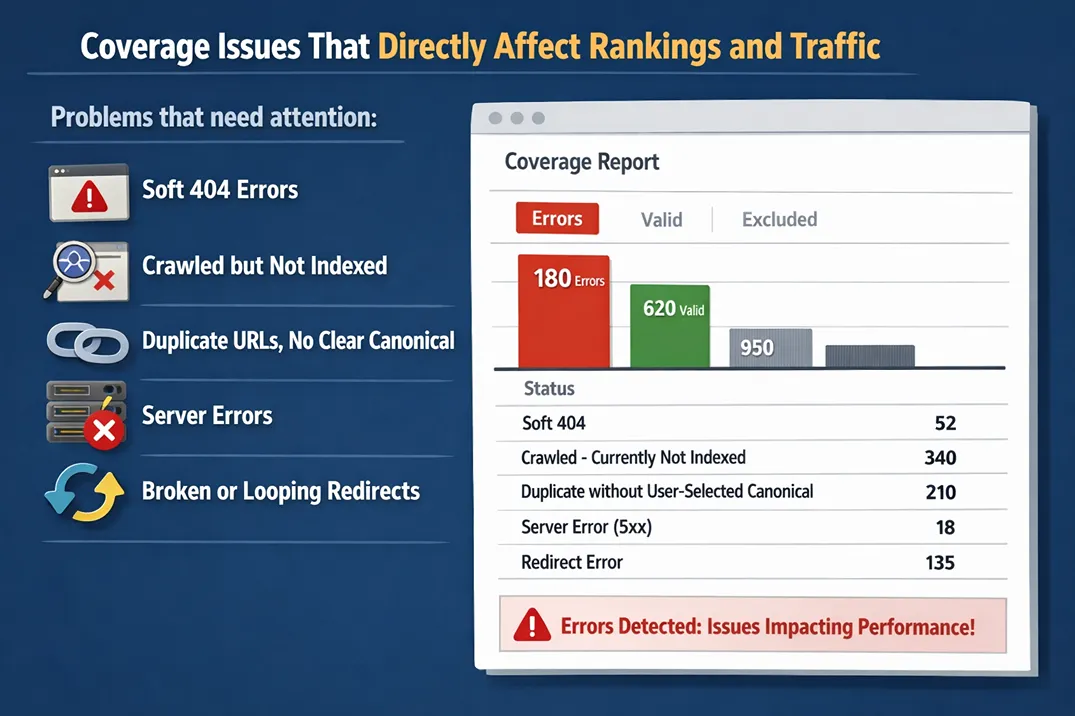
Google Search Console coverage report showing error and excluded page statuses
How to Identify Coverage Errors
The Coverage section in Google Search Console lists all pages Google has crawled and their indexing status. To identify coverage errors:
- 1.Go to Google Search Console and navigate to Coverage
- 2.Filter by "Error" to see only pages with indexing problems
- 3.Review each error type and affected page counts
- 4.Click each error category to see specific URLs affected
- 5.Test individual URLs to understand the specific issue
Priority should go to categories affecting the most pages, as these represent the largest visibility impact.
How to Fix Coverage Errors
Fixing coverage errors requires identifying the specific cause and implementing the appropriate correction. Different error types require different solutions.
Common fixes include:
- Noindex errors: Remove noindex tag from pages that should be indexed, or verify the tag is intentional
- Server errors: Investigate server logs for 5xx errors, fix hosting/technical issues
- Redirect errors: Check redirect chains, repair broken redirects, simplify paths
- Canonical issues: Review canonical tags, fix self-referential canonicals
- Access denied: Check robots.txt for blocking rules, ensure authentication does not block Googlebot
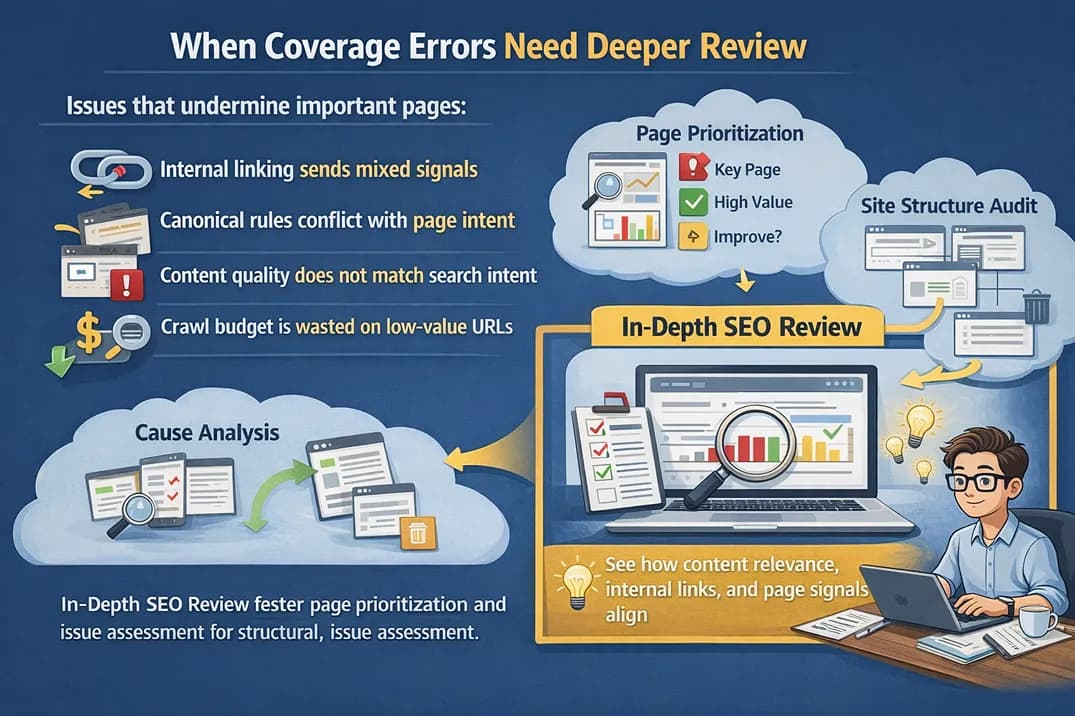
SEO review process showing page prioritisation and issue assessment
When to Prioritise Coverage Error Fixes
Not all coverage errors require immediate attention, but some should be prioritised based on their impact on visibility and business goals.
High priority errors are those affecting important pages (service pages, product pages, high-traffic content) or affecting large numbers of pages. Low priority errors may be on pages that were never meant to be indexed, internal test pages, or obsolete content.
A technical SEO audit helps prioritise which coverage errors to fix first and which are acceptable exclusions, saving development time by focusing effort where it matters most.
Preventing Future Coverage Errors
Once coverage errors are resolved, preventing new ones requires ongoing attention to site structure, technical setup, and monitoring.
Best practices include:
- Regularly review Coverage in Search Console for new errors
- Set up server monitoring to catch 5xx errors early
- Test redirects before deploying changes
- Document noindex decisions to avoid accidental exclusions
- Review canonical tags during content updates
Monitoring for coverage errors should become part of ongoing SEO maintenance rather than something addressed only when problems become severe.
Frequently Asked Questions
Coverage errors are pages Google attempted to index but could not, due to a specific technical barrier such as a server error, redirect loop, or noindex tag. Excluded pages are pages Google chose not to index, often because they are duplicates, canonicalised to another URL, or blocked by robots.txt. Errors require fixes. Exclusions may be intentional or may indicate a structural issue worth investigating.
You can use the URL Inspection tool in Search Console to request indexing after fixing an error, but this only queues a crawl attempt — it does not guarantee immediate inclusion. For large numbers of affected pages, submitting an updated sitemap and improving internal linking is more effective than requesting indexing for individual URLs. Google will recrawl and reindex fixed pages as part of its normal crawl cycle.
It depends on your site's crawl frequency. Pages on well-established sites with strong internal linking may be recrawled within days. Newer sites or pages with weak internal links may take several weeks. Using URL Inspection to request indexing can speed this up for individual pages, but broader fixes across many pages rely on your site's regular crawl schedule.
Yes. A page that was previously indexed and ranking can develop a coverage error if a noindex tag is accidentally added, a redirect is broken, or the server starts returning errors. In these cases, the page may drop out of the index and lose its rankings until the error is resolved and the page is reprocessed.
This error means Google has chosen a different URL as the canonical version of the page you submitted. It usually occurs when there are duplicate pages, inconsistent canonical tags, or redirect chains that point to a different URL. Google is consolidating the page's signals to the URL it considers the primary version. To fix it, ensure your canonical tags consistently point to the correct URL and that the submitted URL does not redirect elsewhere.
Not necessarily. Many excluded pages are intentional — pagination, filtered URLs, admin pages, and duplicate content that should not be indexed. The concern arises when pages you want indexed appear in the excluded list. Review excluded pages periodically to confirm that important content is not being unintentionally blocked by noindex tags, robots.txt rules, or canonical redirects.