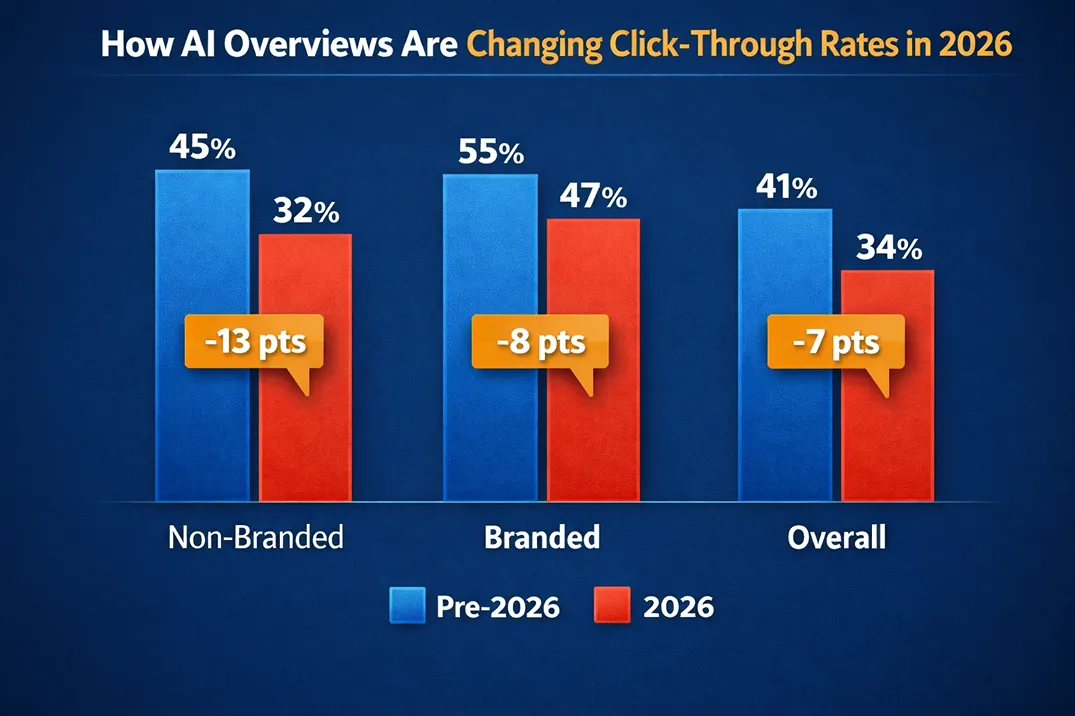
Zero-Click Searches and SEO Strategy in 2026
Zero-click SEO strategy in 2026 means adapting your approach so your business gains value from search visibility even when users do not click through to your site. This involves optimising content for SERP feature ownership (AI Overviews, featured snippets, local packs), protecting transactional keywords, building owned audience channels, and measuring brand visibility, not just organic sessions.
More than 80% of all Google searches now end without the user clicking through to any website, according to Similarweb . On mobile, that figure is slightly lower at around 77%, since mobile users more often tap through to complete actions. This is not a prediction. It is current behaviour measured across billions of queries.
Zero-click searches have been increasing for years, driven by featured snippets, knowledge panels, and People Also Ask boxes. The rollout of AI Overviews has accelerated the trend significantly. Queries that trigger AI Overviews carry a zero-click rate of roughly 83%, compared to around 60% for queries without them. AI Overviews now appear on approximately 15-25% of all searches, and that percentage is expanding as Google rolls the feature out to more query types and more countries, including Australia.
If your organic traffic is declining despite stable rankings, zero-click features are likely absorbing your impressions. This article explains what is consuming your clicks, why zero-click is not the same as zero value, and how to adjust your SEO approach so that your business benefits from visibility even when users do not visit your site.
What Zero-Click Searches Are and Why They Matter
A zero-click search happens when someone types a query into Google and gets the answer they need directly on the results page, without clicking through to any website.
Simple examples include currency conversions, weather queries, and definitions. But zero-click behaviour has expanded well beyond quick facts. Users now get detailed answers to complex questions through AI Overviews, product comparisons through shopping panels, and local business information through map packs, all without leaving the search page.
For businesses that depend on organic search traffic, this creates a real problem. Your pages can rank well, appear in search results, and still generate fewer visits than they did a year ago. The decline is not caused by ranking changes. It is caused by users getting what they need before they reach your site.
Understanding this shift matters because the correct response is not to fight it. It is to adapt your strategy so that your business gains value from visibility on the search page itself, not only from clicks. For a deeper look at how indexed pages can rank without generating clicks, that pattern predates AI Overviews and is now significantly amplified by them.
Which SERP Features Are Consuming Your Clicks
Several types of search features now answer queries directly on the results page. Each one reduces the need for users to click through to a website.
AI Overviews
Google's AI-generated summaries appear at the top of results for a growing range of queries. They combine information from multiple sources into a single answer. For informational queries, they are the primary reason click-through rates have dropped so sharply in 2026. For a detailed breakdown of exactly how this affects organic and paid CTR, see how AI Overviews are changing click-through rates in 2026.
Featured Snippets and People Also Ask
Featured snippets sit at position zero, above traditional organic listings. Google extracts a passage from a web page and displays it directly on the results page. They still earn roughly 8% of clicks, making them valuable real estate even as they contribute to zero-click behaviour.
People Also Ask boxes expand inline, answering follow-up questions without requiring a click. Keywords that trigger both AI Overviews and featured snippets see the largest CTR drops, averaging around 37%, because both features crowd out traditional organic results above the fold. If your pages are indexed but not generating clicks, this stacking of SERP features is often the cause.
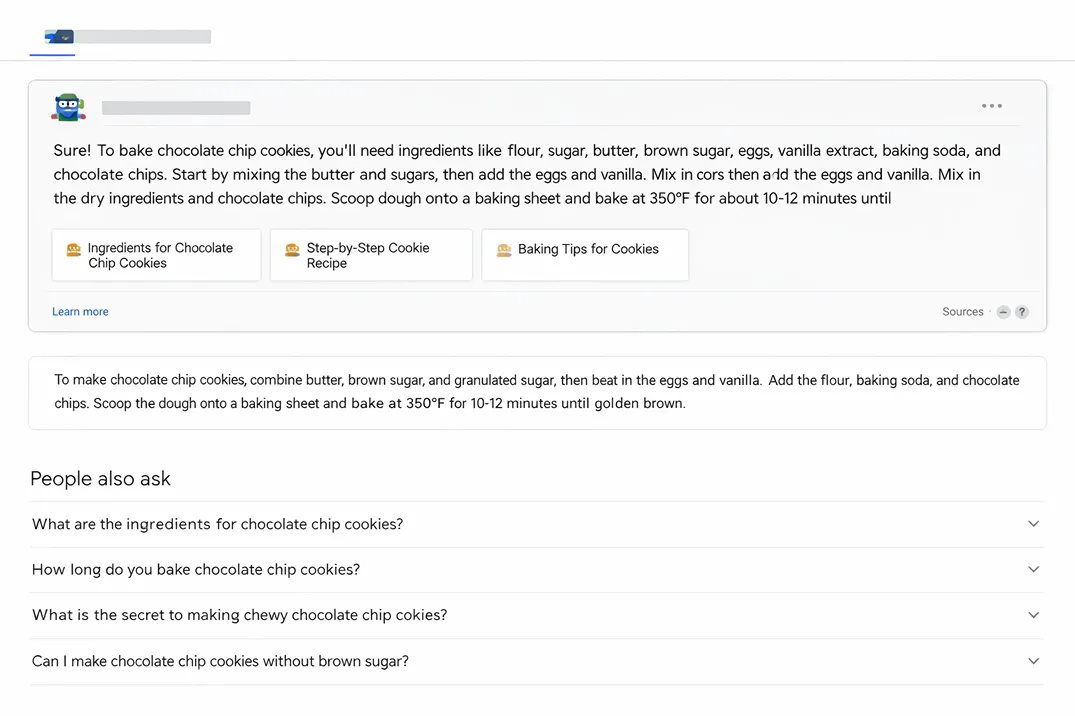
Multiple SERP features appearing above organic results on a single query
Knowledge Panels and Direct Answers
Factual queries like unit conversions, stock prices, and historical dates are answered instantly through Google's own panels. Local packs show business hours, reviews, phone numbers, and directions without requiring a website visit.
These features have existed for years, but their scope keeps expanding. Google is steadily increasing the range of queries it can answer without sending users to external sites.
The Zero-Click Opportunity Most Businesses Miss
Zero-click does not mean zero value. This is the most important concept to understand when adjusting your approach.
Every time a user sees your brand name cited in an AI Overview, featured in a snippet, or displayed in a knowledge panel, that is a brand impression. The user may not click, but they see your business name associated with the answer to their question. This builds recognition and trust over time.
A pattern emerging in 2026 is what some analysts call two-step behaviour. Users read the AI summary first, then click through to verify specific details or get more depth. The initial answer satisfies curiosity, but when the user is ready to take action, they return to the source they saw cited. If that source is your business, you receive a higher-quality visit from someone who already trusts your expertise.
There is also a downstream effect. Users who see your brand in AI answers often search for your business name directly in a later session. This shows up as branded search volume in your analytics, as indirect traffic generated by zero-click visibility that you would miss entirely if you only tracked direct clicks.
The clicks you do receive from AI-referenced content tend to come from users further along in their decision process, which means higher conversion rates even if visit volume is lower. For Australian small-to-medium businesses, this is the opportunity: earn citations now, before competitors catch up.
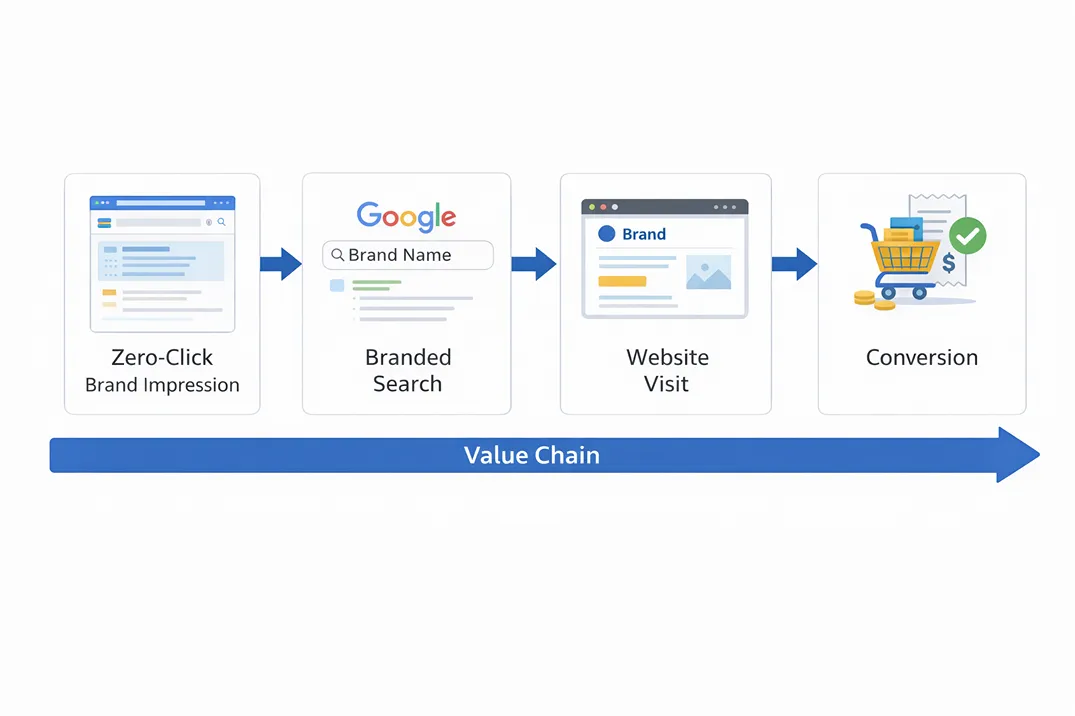
How zero-click visibility leads to conversions through branded search and direct visits
A Practical Framework for Zero-Click SEO
Adapting to zero-click search does not mean abandoning traditional SEO. It means adding new priorities alongside your existing approach.
1. Categorise Your Keywords by Click Potential
Not all keywords are equally affected by zero-click behaviour. Group them by realistic click potential so you allocate effort where it will produce results, and stop measuring every keyword against the same CTR benchmark.
- High click potential: transactional queries, purchase-intent searches, and detailed comparison queries where users need to visit a site to complete an action
- Medium click potential: complex research queries that require multiple sources or in-depth analysis beyond what an AI summary can provide
- Low click potential: definitions, quick facts, conversions, and simple how-to queries that AI can answer completely on the results page
For high click potential keywords, optimise for traditional rankings and conversion. For low click potential keywords, optimise for brand visibility and citation. The on-page SEO signals that earn citations differ from those that simply improve rankings. Structure and directness matter more.
2. Optimise for SERP Feature Ownership
If SERP features are consuming clicks, the goal is to be inside those features rather than competing beneath them.
- For featured snippets, structure content with clear definitions in 40-60 words, use tables for comparisons, and use ordered lists for process-based queries
- For People Also Ask, use question-based H2 and H3 headings with concise single-paragraph answers directly below each heading
- For AI Overviews, lead with answer blocks, include data and citations, and structure content for AI Overview citation eligibility
- For local packs, maintain an optimised Google Business Profile, build citations through business listing submissions, and gather reviews consistently
Each feature type requires a different formatting approach, but the principle is the same: if you cannot beat the feature, become the source inside it. Good SEO content writing for 2026 is built around this principle from the first draft.
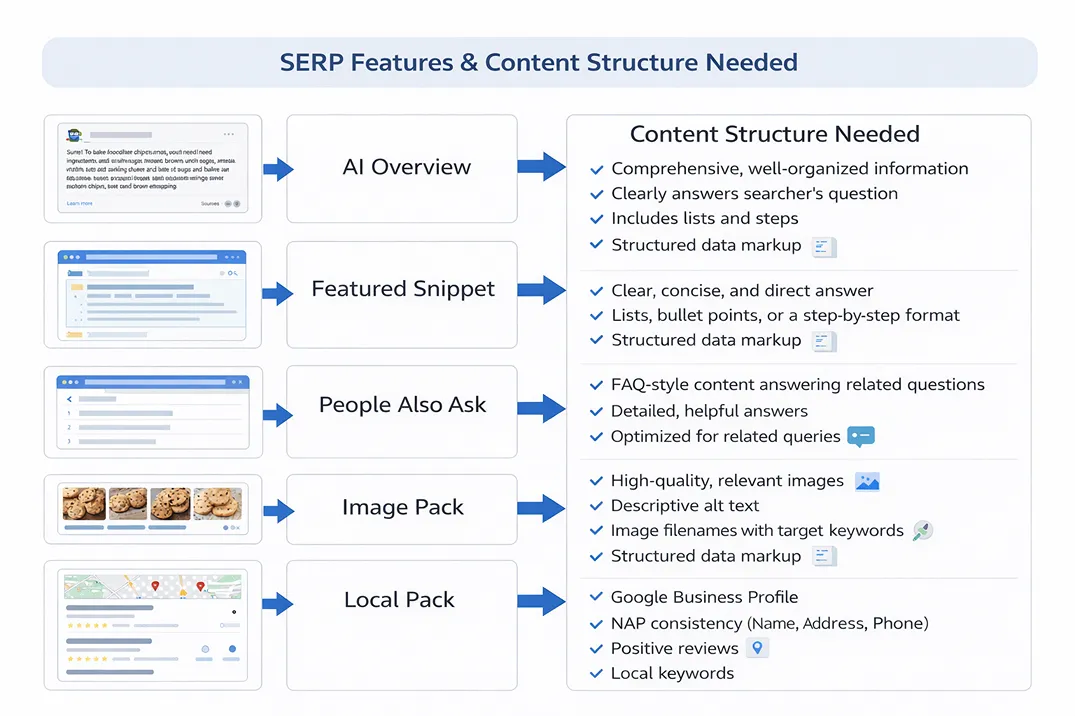
Content structure needed to appear in each type of SERP feature
3. Protect Your Revenue Keywords
Identify which of your revenue-generating keywords now trigger AI Overviews or other zero-click features. These are the keywords that directly lead to enquiries, sales, or bookings.
For these keywords, ensure your content is structured for citation, not just ranking. If your service page ranks third but is not cited in the AI Overview, the traffic you receive will be a fraction of what it was 12 months ago.
Also reconsider your paid search budget on these queries. Paid CTR on queries with AI Overviews has fallen significantly. If you are paying the same cost per click but receiving far fewer clicks, the return on that spend has deteriorated. Reallocating budget toward lower-funnel, transactional keywords where CTR is still strong often produces better results. A technical SEO audit can map exactly which revenue keywords are now affected and what to prioritise.
4. Build an Owned Audience
Zero-click search is a reminder that relying entirely on Google for traffic is a structural risk. When the platform changes how it displays results, your traffic changes with it, and you have no control over the timing or extent.
Building channels you own, such as email lists, push notification subscribers, and community groups, gives you direct access to your audience regardless of what happens in search results. These channels bypass SERP changes entirely.
Use your current search visibility to drive signups. If your pages appear in AI Overviews or featured snippets, some users will still visit your site. Make sure those visits include a clear path to subscribe, join, or save your content for later. Converting a search visitor into a subscriber means you do not need to compete for their attention through Google again.
5. Shift to Visibility-First Metrics
If your reporting only tracks organic sessions and CTR, you are measuring less than half of your actual search performance. Add these metrics alongside your existing ones.
- SERP feature share: how often your pages appear in AI Overviews, snippets, and PAA boxes compared to competitors
- AI Overview citation frequency: how many of your target keywords cite your content in the AI answer
- Branded search volume: whether people are searching for your business name more often over time
- Assisted conversions: users who saw your brand in AI results and later converted through another channel
Think of measurement in layers: impressions, then SERP feature presence, then brand lift, then revenue. This gives you a complete picture rather than one that only counts direct clicks.
Content Types That Still Earn Clicks in 2026
Not all content is equally affected by zero-click behaviour. Some formats continue to generate visits because users cannot get what they need from a search page summary alone.
Bottom-of-Funnel Content
Pricing breakdowns, detailed case studies with specific metrics, comparison pages, and service pages with clear calls to action still produce clicks. Users at this stage need to evaluate specific options and take action, which requires visiting a website. If your site relies heavily on top-of-funnel blog content for traffic, strengthening your bottom-of-funnel pages should be a priority. Understanding when technical SEO is the limiting factor versus when it is a content strategy problem will help you prioritise correctly.
Content AI Cannot Easily Replicate
AI summaries are good at synthesising existing information. They are less effective at providing original research, proprietary data, expert interviews, first-person perspectives, and interactive tools.
If your content offers something that cannot be summarised from other sources, users have a reason to click through. This is where interactive SEO tools, original data sets, and detailed local guides with insider knowledge create a genuine competitive advantage that AI cannot flatten.
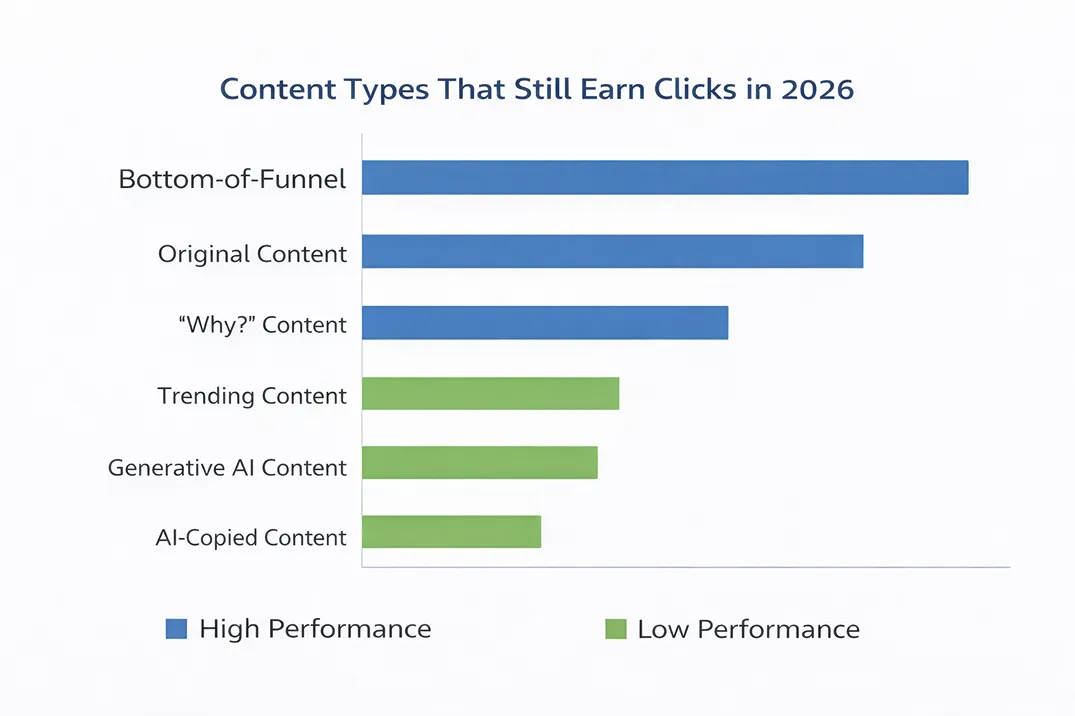
Content types ranked by click resilience in a zero-click search environment
Local and Transactional Content
Users still click when they need to book an appointment, check availability, compare local service providers, or complete a purchase. These actions cannot be completed within a search result.
For local businesses, this means maintaining an optimised Google Business Profile, building consistent business listings across directories, and creating location-specific service pages with unique, detailed content. For businesses operating across multiple locations, see how local SEO works for multi-location businesses in Australia. Local searches still produce clicks when the user needs to interact with a specific business.
What This Means for Australian Businesses
AI Overviews are live in Australia and expanding to more query types. The zero-click trend is not something that only affects US or UK markets. Australian businesses across every industry are seeing the same patterns in their Search Console data.
The good news is that small-to-medium businesses can compete effectively in this environment. AI systems do not only favour large brands. They favour content that is well-structured, specific, current, and backed by real expertise. A focused business with deep knowledge of its niche can earn citations that larger competitors with generic content miss entirely.
The window to establish your position is now. Most businesses have not yet adapted their content strategy for zero-click and AI citation. Those that move first will have a significant advantage as the rest of the market catches up.
A practical starting point: audit your top 20 keywords this week. Check which ones trigger AI Overviews or other zero-click features. Note whether your content is cited. If it is not, that is your priority list for the next quarter. If you want a structured assessment, an hourly SEO consultation or a full technical SEO audit can map out exactly where you stand and what to change first. For businesses dealing with indexing or coverage errors alongside declining CTR, resolving crawl issues is always the first priority before optimising for citations.
Frequently Asked Questions
Need Help Adapting to Zero-Click Search?
If your organic traffic is declining despite stable rankings, zero-click features are likely absorbing your impressions. A targeted audit identifies which keywords are affected, whether your content is being cited, and what to fix first, so you stop losing visibility you have already earned.